
By Emma Peter, Abuja
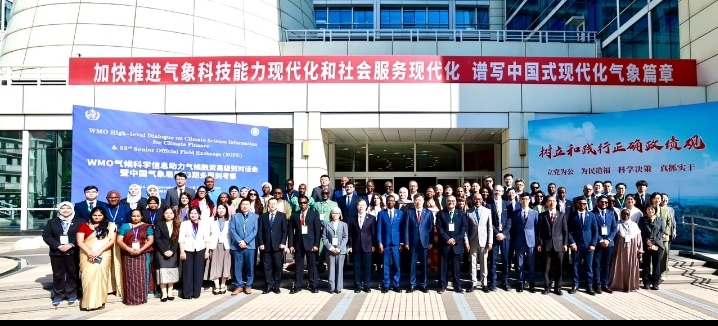
The Director-General of the Nigerian Meteorological Agency (NiMet), Prof. Charles Anosike, has participated in a high-level World Meteorological Organization (WMO) dialogue focused on strengthening the role of climate science in mobilising climate finance and advancing effective early warning systems.
The WMO High-Level Dialogue on Climate Science Information for Climate Finance and the 53rd Senior Official Field Exchange (SOFE) were held in Beijing, China, from September 14 to 18, 2026.
The high-level engagement brought together senior officials and stakeholders to explore practical approaches to strengthening National Meteorological and Hydrological Services (NMHSs) and enhancing their contribution to climate resilience, disaster risk reduction and access to climate finance.
According to the WMO, discussions during the High-Level Dialogue centred on strengthening the leadership and capacity of NMHSs to mobilise climate finance, while ensuring that scientific and technical capabilities are aligned with risk-informed and people-centred early warning systems.
The participants also examined ways of transitioning from conventional technical assistance towards sustainable investment through stronger practical cooperation between meteorological institutions and multilateral financing entities.
The dialogue further emphasised the need to strengthen strategic thinking among NMHS leadership and build productive partnerships capable of translating climate science and meteorological information into sustainable investments and practical climate action.
Held alongside the high-level dialogue was the 53rd Senior Official Field Exchange to Fujian Province, which provided participants with first-hand exposure to China’s implementation of the Multi-hazard, Alert, Zero-gap and Universal (MAZU) platform.
The MAZU platform, an artificial intelligence-driven meteorological early warning solution, supports the Early Warnings for All (EW4All) initiative and forms part of China’s efforts to strengthen disaster risk reduction through technology-enabled forecasting and early warning.
The field exchange featured technical discussions, field visits and peer-learning sessions designed to give participating officials practical insight into the deployment and application of advanced meteorological technologies.
Anosike’s participation in the WMO engagement provided an opportunity for Nigeria to exchange knowledge and experiences with international counterparts on climate science, climate finance, early warning systems and innovative technologies for reducing the impact of weather- and climate-related disasters.
The engagement also underscored the growing importance of stronger partnerships among National Meteorological and Hydrological Services, international organisations and financing institutions in converting climate information and scientific knowledge into practical investments capable of protecting lives, livelihoods and communities.