
By Emma Peter, Abuja
The North Central Development Commission (NCDC) has taken a major step towards establishing a long-term development framework for the region, following the adoption of a seven-point communiqué at the maiden North Central Stakeholders’ Development Summit in Abuja.
The two-day summit, held under the theme, “The Great Leap Forward: A 20-Year Economic, Infrastructural and Social Development Plan for the North Central Region,” brought together stakeholders to deliberate on strategies for accelerating economic growth, infrastructure development and social progress across the region.
According to a statement issued by the Head of Media and Corporate Communications Department of the NCDC, Dr. Makut Simon Macham, the communiqué was read at the end of the summit by the NCDC Executive Director, Finance and Chairman of the Technical Committee, Prof. Muhammad Bashar Nuhu.
Participants identified economic development, infrastructure, social development, security, climate and environment, digital economy, as well as sustainable financing and institutional delivery as major priorities for the region’s long-term development.
The summit observed that the North Central has significant agricultural land, water, mineral and energy resources, human capital, markets and strategic geographical advantages. However, participants noted that these resources have not consistently translated into corresponding productivity, income levels, industrial capacity and improved social outcomes.
To address the challenge, the summit recommended the development of a Geographic Information System-enabled regional economic database, alongside state-by-state mapping of comparative advantages, productive assets, agricultural resources, minerals, infrastructure gaps and investment opportunities.
It also proposed state-specific agricultural and livestock value chains covering improved inputs, mechanisation, irrigation, farmer capacity building, storage, processing, packaging, branding, logistics and exports.
The summit recommended that priority agricultural projects be properly sequenced and developed into bankable quick-win initiatives capable of attracting investment and generating economic opportunities.
On infrastructure, participants called for an integrated North Central programme connecting the six states and the Federal Capital Territory through strategic road, rail, inland-waterway and logistics networks.
The proposed programme would prioritise the rehabilitation and completion of corridors that can unlock agricultural production, markets and investment, with urgent attention to major routes including the Abuja–Lokoja Road.
The summit also recommended examining the phased feasibility of regional rail connectivity, Baro inland-port logistics, dry-port connections and modern freight systems.
In the area of human capital and social development, participants proposed a regional data system covering children, youths, women, persons with disabilities, indigent households and rural communities to support needs-based interventions and enable effective measurement of outcomes.
They further called for a safe and inclusive education framework focused on reducing school dropout, strengthening existing schools, addressing teacher shortages, improving affordability and learning quality, and providing accessible facilities and learning materials for persons with disabilities.
Security was also recognised as central to the region’s development. Participants recommended a coordinated regional security and peacebuilding framework to support statutory security agencies through timely intelligence sharing, community engagement, early warning mechanisms and inter-state coordination.
The summit further advocated the responsible and lawful deployment of satellite imagery, drones, geospatial systems and other technology-enabled intelligence tools, supported by clear operational safeguards and response protocols.
On climate and environmental concerns, participants proposed a North Central Climate and Disaster Resilience Programme.
The proposed programme would begin with geo-referenced mapping of flood, erosion, drought, mining and other environmental risks, followed by community risk profiling, early-warning systems and effective evacuation protocols.
It would also prioritise interventions such as desilting, drainage clearing, protection of waterways and erosion control, while encouraging a review of dam and reservoir solutions and stronger enforcement against unsafe development along flood-prone corridors.
The digital economy also featured prominently in the recommendations, with the summit urging the NCDC to develop an inclusive regional digital infrastructure programme to expand broadband connectivity and affordable digital access across the six states, the FCT, local governments, wards and underserved rural communities.
Participants further recommended the establishment of artificial intelligence, digital-skills and teacher-training centres across the Mandate States, beginning with functional computer-enabled facilities in primary schools and progressively expanding access to technology-supported education.
On financing, the summit acknowledged that public resources alone would not be sufficient to meet the region’s development ambitions.
It therefore recommended that financing mechanisms be matched with the economic and public value of individual projects, with commercially viable projects attracting private investment, projects with strong economic benefits but weaker initial returns accessing blended finance, and essential non-commercial services receiving appropriate public funding.
For sustainability, participants called for the 20-Year Plan to receive formal legal and institutional backing through adoption, aligned state action and governance arrangements capable of sustaining implementation beyond electoral cycles.
The summit also recommended the establishment of a Programme Management Office within the NCDC to coordinate flagship programmes, project preparation, financing, implementation support, risk management, stakeholder engagement and performance reporting.
It further called for clearly defined responsibilities among the NCDC, Mandate States, FCT, federal institutions, local governments, traditional institutions, the private sector, communities and development partners, with an accountable owner and resource pathway for every intervention.
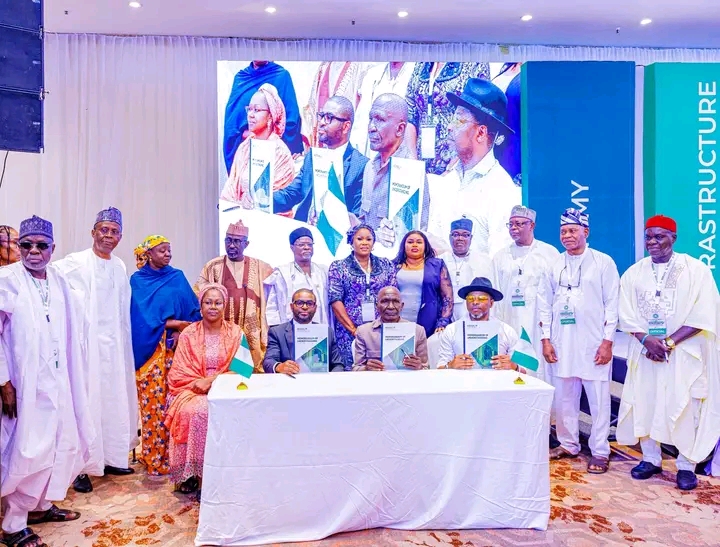
As part of efforts to translate the development agenda into practical economic partnerships, the NCDC signed Memoranda of Understanding with the Nigeria Incentive-Based Risk Sharing System for Agricultural Lending (NIRSAL) and the Small and Medium Enterprises Development Agency of Nigeria (SMEDAN).
The agreements followed months of engagements and visits by the Commission to both agencies and are designed to leverage their expertise, structures and experience in unlocking the agricultural and entrepreneurial potential of the North Central.
The partnerships are expected to strengthen agricultural value chains, promote entrepreneurship and enterprise development, and contribute to making the region more economically productive and viable.
NCDC Managing Director and Chief Executive Officer, Dr. Cyril Yiltsen Tsenyil, NIRSAL Executive Director, Ewaen Imohe, and SMEDAN Director-General, Charles Odii, pledged their commitment to the partnerships.
The Chairman of the NCDC Governing Board, Barr. Cosmas Akighir, and the Permanent Secretary, Ministry of Regional Development, Dr. Mary Ogbe, also expressed support for the agreements and pledged appropriate oversight.
In his closing remarks, Dr. Tsenyil thanked participants for their active and patriotic participation, noting that their contributions would help shape the performance and long-term legacy of the Commission.
Chairman of the Central Steering Committee, Alhaji Suleiman Baba Ali, commended the level of participation at the summit and expressed appreciation to President Bola Ahmed Tinubu, special guests and stakeholders for attending and contributing to the discussions.
He also appreciated members of the Central Steering Committee and the various sub-committees for their sacrifices, commitment and dedication towards ensuring the success of the summit.
The development blueprint and the partnerships with NIRSAL and SMEDAN are expected to provide the NCDC with a broader framework for coordinating investment, infrastructure, agriculture, enterprise development and social interventions across the North Central region.