
BY EMMA PETER, ABUJA
The Comptroller-General of the Nigeria Customs Service, Bashir Adewale Adeniyi, has charged officers of the Customs Police Unit (CPU) to uphold discipline, professionalism and accountability, declaring that the integrity of the Service must begin with its personnel.
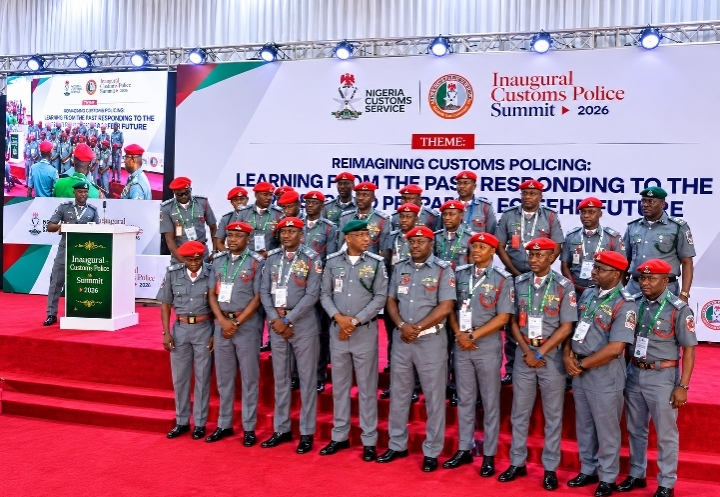
Adeniyi gave the charge while delivering the keynote address at the inaugural Customs Police Summit 2026, held at the NAF Conference Centre and Suites, Abuja, where he stressed the importance of a disciplined and trusted enforcement unit in strengthening Customs administration and combating illicit trade.
The Comptroller-General, who also chairs the World Customs Organization (WCO) Council, said the Service had a dual responsibility of facilitating legitimate trade and preventing illicit activities, noting that achieving both objectives required an enforcement unit committed to upholding institutional standards.
“Customs must facilitate legitimate trade and stop illicit trade, and it can do neither without a disciplined and trusted police unit to uphold its own standards,” he said.
Tracing the history of Customs administration in Nigeria to 1891, Adeniyi recalled that a Preventive Service with an enforcement arm was established by 1945, while the Customs Police Unit was inaugurated in July 2019 with the mandate to investigate erring personnel, prevent crime and ensure compliance.
He commended successive Provost Marshals and personnel for their contributions to building the unit over the past seven years, reaffirming that its founding principle remained that “no officer is above the law.”
The Customs chief identified three major lessons from the Service’s history, stressing that integrity must begin within the institution, authority must be exercised with restraint, and enforcement agencies must work collaboratively.
“Charity begins at home. Before we demand integrity from traders and the public, we must show it ourselves,” he declared.
He noted that although the Nigeria Customs Service Act 2023 provides the Service with police powers, such authority must be exercised strictly within the law, adding that every search, arrest and detention must have lawful justification and withstand public and judicial scrutiny.
Adeniyi expressed concern over the increasing sophistication of criminal networks, which exploit legitimate trade routes and digital platforms to move firearm components, narcotics, counterfeit medicines, protected wildlife and illicit funds.
He, however, maintained that the response to these emerging threats must be driven by intelligence, technology and improved risk management.
“Our answer must be smarter, not harder,” he said, advocating greater application of international Customs instruments, including the SAFE Framework, Authorised Economic Operator programme, advance rulings, Time Release Study and Revised Kyoto Convention.
According to him, these instruments promote compliance, facilitate legitimate trade and allow enforcement officers to concentrate on genuine security risks while reducing opportunities for abuse and corruption.
He also highlighted the growing importance of technology and information management, citing the B’Odogwu digital platform, which integrates declarations, valuation, risk management and Authorised Economic Operator processes, as well as the INTERPOL Data Centre at Customs Headquarters, which provides access to global criminal databases.
Adeniyi described the Customs Police Unit as central to maintaining institutional integrity, ensuring that enforcement discretion is exercised lawfully and that successful interceptions translate into effective prosecutions.
“Above all, it is the guardian of our integrity,” he said.
Outlining the strategic direction for the unit, the Comptroller-General identified three pillars: Consolidation, Collaboration and Innovation, which he said must guide its future operations and development.
He explained that consolidation would involve institutionalising best practices through clear procedures for arrest, detention and investigation, improved case-file preparation and continuous professional development for personnel.
On collaboration, he called for stronger working relationships with the Nigeria Police Force, Armed Forces, National Drug Law Enforcement Agency (NDLEA), National Agency for Food and Drug Administration and Control (NAFDAC), Department of State Services (DSS), Independent Corrupt Practices and Other Related Offences Commission (ICPC), Nigeria Agricultural Quarantine Service (NAQS), neighbouring countries and border communities.
He stressed that no single institution could successfully combat illicit trade without effective partnerships and mutual trust.
On innovation, Adeniyi advocated the deployment of artificial intelligence, advanced scanners, geospatial tools and electronic cargo tracking to improve investigations and strengthen enforcement operations.
He cautioned, however, that technology must remain subject to the law, explaining that while algorithms could identify potential risks, enforcement decisions must be made by authorised officers operating within established legal frameworks.
“Algorithms may flag risks, but only officers acting within the law can exercise enforcement powers, with audit trails, data protection and human oversight at every step,” he stated.
The Comptroller-General urged participants to ensure that the summit produced four key outcomes, including a Customs Police doctrine anchored in the NCS Act 2023 and the Revised Arusha Declaration, workable protocols for joint operations, evidence management and information exchange, responsible guidelines on the use of data and artificial intelligence in investigations, and practical recommendations on the training, welfare and recognition of CPU personnel.
Addressing officers and men of the unit, Adeniyi urged them to preserve established standards, correct institutional weaknesses and contribute to building a more professional enforcement structure.
“Keep what is right, repair what is not, and build what comes next,” he charged.
He reminded them that the Red Beret they wear represents the trust of Nigerians and the reputation of the Nigeria Customs Service, urging them to wear it with discipline, restraint and pride.
“Never forget that charity begins at home, for integrity remains the greatest badge you carry,” he emphasised.
Adeniyi subsequently declared the inaugural Customs Police Summit 2026 open, expressing appreciation to the ACG Headquarters, Acting Provost Marshal, organising committee and partner agencies for their contributions to the initiative.