

By Oxford Reporters
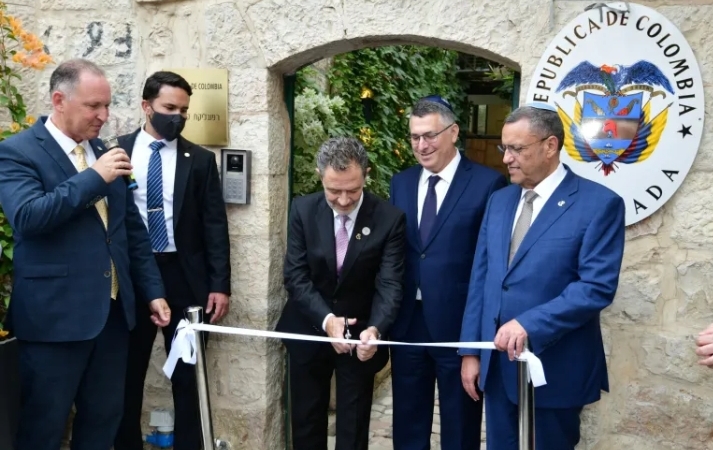
Colombia has opened its embassy to Israel in Jerusalem, marking a significant shift in the country’s foreign policy and drawing strong condemnation from Palestinian officials, who described the move as a violation of international law.
The embassy was inaugurated on Wednesday, October 14, 2026, by Colombian Foreign Minister Omar Bula Escobar and his Israeli counterpart, Gideon Saar, under the administration of Colombian President Abelardo de la Espriella.
The decision represents a major departure from the foreign policy of former Colombian President Gustavo Petro, who severed diplomatic relations with Israel in 2024 over its military campaign in Gaza.
Since assuming office in August 2026, De la Espriella has moved to strengthen relations with Israel, including restoring a free trade agreement that was terminated by his predecessor.
Speaking at the inauguration ceremony, Bula Escobar said diplomatic relations between the two countries should never have been severed, describing the embassy’s opening as a concrete step towards rebuilding bilateral ties.
“Israel is a strategic partner. It always has been, and from now on, it will be an even stronger one,” the foreign minister said.
Israeli Foreign Minister Gideon Saar welcomed the development, describing it as an important moment for Israel and the city of Jerusalem.
Colombian Ambassador to Israel, Tania Gilinski, also reaffirmed her country’s commitment to strengthening relations with Israel, expressing confidence that the partnership would grow stronger following the embassy’s relocation.
However, the decision has triggered criticism from Palestinian authorities, who maintain that Jerusalem’s status must be resolved through negotiations in accordance with international law.
The Palestinian Authority condemned Colombia’s move, describing it as a violation of international resolutions and a challenge to the international consensus on the legal status of the holy city.
Jordan’s Ministry of Foreign Affairs also criticised the decision, calling it a violation of international law and relevant international resolutions.
Jerusalem remains one of the most contentious issues in the Israeli-Palestinian conflict. Israel regards the entire city as its capital, while Palestinians consider occupied East Jerusalem the capital of a future independent Palestinian state.
Israel occupied East Jerusalem during the 1967 Middle East war and subsequently annexed it, a move that has not been recognised by the vast majority of the international community.
Most countries maintain their embassies in Tel Aviv rather than Jerusalem, arguing that the city’s final status should be determined through negotiations between Israelis and Palestinians.
The United States relocated its embassy from Tel Aviv to Jerusalem in 2018 during President Donald Trump’s first administration, a decision that provoked widespread Palestinian opposition and international criticism.
Since then, a small number of countries have followed Washington’s example, including Fiji, Guatemala, Honduras, Papua New Guinea, Paraguay and Nauru. Kosovo and Somaliland have also established diplomatic missions in Jerusalem, although neither is a United Nations member state.
Colombia’s decision adds to the limited number of countries that have chosen to establish their embassies in Jerusalem, further highlighting the international divisions surrounding the city’s political and legal status.
The development comes amid continued international scrutiny of Israel’s military campaign in Gaza, where attacks over the past three years have killed more than 74,000 people, according to figures cited in the original report.