

By Emma Peter, Abuja
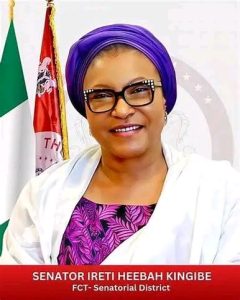
As the political temperature gradually rises ahead of the 2027 general elections, attention is returning to the Federal Capital Territory (FCT) Senate seat, where incumbent Senator Ireti Heebah Kingibe is preparing to seek another term after securing the African Democratic Congress (ADC) ticket for the senatorial contest.
Kingibe’s re-election bid will take place against the background of her first-term record in the Senate, a period in which she has combined legislative advocacy with constituency interventions covering education, healthcare, agriculture, electricity, digital skills, roads, water and direct economic empowerment.
Her political challenge in 2027 is expected to include a familiar name in FCT politics, former Senator Philip Aduda, who represented the territory in the Senate from 2011 to 2023 before losing the seat to Kingibe in the 2023 election. Aduda resigned from the Peoples Democratic Party in March 2026, amid reports that he was preparing to move towards the All Progressives Congress.
The 2023 election itself remains an important part of the political background. Kingibe defeated Aduda in that contest, while subsequent legal challenges by Aduda did not overturn the result, with both the election tribunal and Court of Appeal upholding Kingibe’s victory.
But the emerging 2027 contest is not simply about personalities. It is also likely to be tested against the records candidates present to FCT voters.
For Kingibe, one of the strongest components of that record is the breadth of her constituency interventions.
During the first phase of her tenure, her office reported empowerment programmes involving thousands of residents, including grants to artisans across the six area councils. Her published first-year project report records SMEDAN grants of N100,000 each for 500 beneficiaries in AMAC, Bwari and Kuje, and another 500 beneficiaries across Kwali, Abaji and Gwagwalada.
The senator has also placed considerable emphasis on skills development. In one reported programme, more than 1,000 women and youths were trained as social-media experts and reportedly received N250,000 each as part of the empowerment package. Other interventions included entrepreneurship training for FCT youths and distribution of equipment such as grinding machines, deep freezers, generators, barbecue stands and cooking equipment to selected women.
Her approach has increasingly extended beyond one-off distributions to platforms designed to maintain contact with constituents. Her official website lists community engagement hubs across the FCT and identifies indigenous-community engagement, youth development, job creation and an inclusive digital economy among her policy priorities.

Education has also featured prominently in the senator’s constituency agenda.
Kingibe has sponsored JAMB registration for 2,000 FCT students, while also promoting skills and career-development opportunities. Her constituency office has reported training programmes involving young people and women, while her current SkillMeIRETI platform lists opportunities spanning digital, creative, education, healthcare, agriculture, banking and fintech, clean energy and other sectors.
At the legislative level, Kingibe has pursued issues connected directly with education and healthcare. National Assembly records show her sponsorship of the Federal Capital Territory School of Nursing and Midwifery (Establishment) Bill, 2023. She was also listed as a sponsor of a bill concerning the establishment of a Federal University of Information and Communication Technology in Ikare-Akoko.
Healthcare represents another significant part of her constituency profile.
Her office has reported the construction of a 50-bed hospital at Dobi in Gwagwalada and the provision of medical equipment to health facilities across the territory. A 2025 report on her constituency projects cited a reported N500 million worth of medical equipment, as well as a free eye-care programme involving testing, glasses and surgery for thousands of residents.
Kingibe has also spoken publicly about maternal healthcare, including her support for a proposed FCT School of Nursing and Midwifery and a maternal free-healthcare initiative. She has further said that she personally supported the renovation of an antenatal centre at the University of Abuja Teaching Hospital, Gwagwalada.
Her newer healthcare initiative, ASHORE, is presented on her official platform as an FCT rural healthcare assistance programme covering areas including eye care, cancer care, infectious diseases, maternal care, cardiovascular treatment, disability support and universal health coverage.
Electricity and basic infrastructure have similarly featured in Kingibe’s constituency interventions, with projects designed to address some of the everyday challenges confronting communities across the Federal Capital Territory.
Among the documented interventions is the installation of a transformer at Kado Kuchi/Jabi, while her constituency project record also lists the provision and installation of 10 transformers in selected communities across the FCT Senatorial District — five 300/33KVA and five 300/11KVA transformers.
The electricity interventions form part of a wider infrastructure programme that includes solar streetlights, roads, drainage and water projects. Her constituency records identify solar streetlight installations in communities including Ajegunle, GRA, Sangaruwa, Anajie, Gbagi Village and Mashapa Road in the Mpape area, Karimamajiji, Kwali and Jikwoyi.
The intervention at Kado Kuchi/Jabi is particularly notable because electricity supply remains an important concern for communities within the expanding metropolitan area. Beyond the urban centre, the reported transformer programme extends to selected communities across the six-area-council FCT constituency.
Kingibe’s infrastructure portfolio also includes the construction and rehabilitation of roads and drainages, including the 0.6-kilometre asphaltic road at Ishan, Karu, roads and drainage at Kpaduma 1 and 3, the completion of Angwan Dodo Road in Gwagwalada, road and drainage works at Pai in Kwali, and the construction and asphalting of a 1.5-kilometre road in Jikwoyi Phase 1.
The projects are complemented by water interventions. Her constituency records list the rehabilitation of boreholes across AMAC, Bwari, Kwali, Kuje, Gwagwalada and Abaji, alongside specific rehabilitation projects in parts of Kwali, including Yebu Ward, Kundu Ward, Dafa, Ibwa Ward, Ashara Ward and Kwali Central.
Taken together, the electricity, water, roads and solar-lighting interventions provide another dimension to Kingibe’s grassroots representation, particularly for communities where basic infrastructure remains a major part of everyday life.
Agriculture has been another avenue through which Kingibe’s office has attempted to connect with rural constituents. Her constituency report included fertiliser support for FCT farmers, while subsequent reports cited the distribution of two trailer loads of fertiliser and 500 spraying machines. The senator’s policy platform also identifies food security as one of its principal areas of intervention.
Perhaps more significant politically is the geographic spread of the interventions.
Rather than concentrating constituency activities in one part of Abuja, the programmes reported by her office cut across AMAC, Bwari, Kuje, Gwagwalada, Kwali and Abaji. Roads, boreholes, health outreaches, agricultural support, grants, training programmes and educational assistance have been reported across different parts of the FCT.
That spread gives Kingibe a tangible grassroots narrative to take into the 2027 campaign: a record that can be discussed in terms of projects and programmes rather than only political speeches.
Her own explanation of representation has consistently been that a senator’s responsibility is not simply to distribute cash to individuals but to use legislation, lobbying and constituency projects to attract interventions to communities.
That distinction has been central to her public defence of her record. In 2024, she said her office had empowered about 7,000 people and facilitated employment for about 6,500 others, while also reporting JAMB sponsorship, agricultural support, medical equipment, street lighting, roads and the Dobi hospital project.
The senator’s legislative position has also become more prominent as she has settled into the National Assembly. She currently chairs the Senate Committee on Women Affairs, a position that has given her an additional platform to participate in national policy discussions affecting women and vulnerable groups.
Beyond constituency projects, Kingibe has increasingly positioned herself as an advocate on issues concerning the FCT’s place within the national political and administrative structure. In 2026, she publicly questioned aspects of FCT borrowing and maintained that major financial commitments involving the territory should receive appropriate legislative scrutiny. The dispute subsequently became part of her broader political disagreement with FCT Minister Nyesom Wike.
Her political preparation for 2027 has now moved beyond speculation.
In May 2026, Kingibe secured the ADC ticket for the FCT Senate election after recording 17,535 votes in the party’s primary, according to the reported result.
Her movement from the Labour Party to ADC has also provided her with a new political platform for the coming election. She explained that ADC offered an opposition platform for politicians seeking to contest the 2027 elections.
The political landscape around the Senate contest is therefore already taking shape.
On one side is a sitting senator seeking another term, with a constituency record covering six area councils and programmes in education, healthcare, agriculture, digital skills, infrastructure and empowerment. On the other is Aduda, a former senator with more than a decade of experience representing the FCT in the National Assembly and an established political network in the territory.
The contrast between the two records will ultimately be for FCT voters to assess.
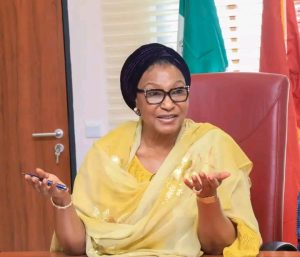
For Kingibe, however, the 2027 campaign provides an opportunity to put her first-term record before the electorate in a more systematic way. Her reported interventions offer a catalogue of projects that stretches from the construction of a 50-bed hospital and rehabilitation of boreholes to transformer installations, solar lighting, roads, agricultural inputs, JAMB registration, medical outreaches, skills acquisition and grants.
Her grassroots strategy is also evolving from conventional political mobilisation towards a more structured constituency-engagement model. Her official platform now provides community engagement hubs across the six municipal zones, while initiatives such as SkillMeIRETI and ASHORE seek to create continuing channels for skills and healthcare assistance.
This may become an important feature of her 2027 campaign because the FCT Senate contest is not only about Abuja’s city centre. It encompasses communities and residents across the six area councils, including rural and indigenous settlements whose concerns often revolve around roads, electricity, water, healthcare, education, agriculture and economic opportunities.
Kingibe’s record, as documented by her office and reported by the media, gives her specific interventions to place before those communities.
Whether those interventions translate into renewed electoral support will ultimately be decided by FCT voters in 2027. What is already clear is that Senator Ireti Kingibe is entering the contest with a record she can point to across multiple sectors, a secured party ticket and a constituency-engagement structure that has continued to expand during her first term.
The coming campaign will therefore provide the electorate with an opportunity to examine what has been delivered, what remains outstanding and what each contender proposes to do with another term in the Senate.
Written by Emma Peter, Journalist based in Abuja. For your Editorial, feature and advertisment please contact us: oxfordreporters52@gmail.com / 09152514499